Networked Media, Produce This!

Keeping up with the Googleses

Google Alerts are a great way to get relevant search results emailed to you directly. It’s good practice for businesses to setup a Google alert for their business name, or any other relevant keywords and phrases, to ensure that they can keep on top of what people may be saying about them (or their competitors!) online. It’s probably a good idea to set one up for your own name too, if you’re trying to build your own personal brand.

I set up four Google Alerts for topics that interest me: interactive fiction, creative writing, screenwriting and online community.

Here are the results that I received for these topics today:

Interactive fiction
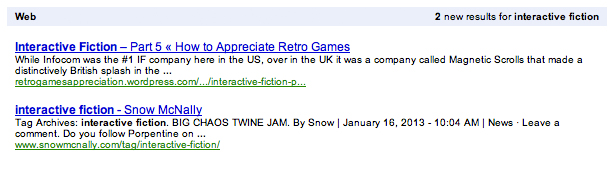
galert01

I actually really enjoyed the first search result – an article from the How To Appreciate Retro Games blog – because I love retro games (especially IF) and I had never seen this blog before. I’m really excited to have found it (and I’ve added it to my RSS reader for quick access in the future!)

The second search result took me to a blog post by Snow McNally. The actual article didn’t interest me but browsing through the blog brought me to an interactive fiction game they had created called Lethal Elevator From Hell, which is pretty cool. It’s a digital narrative developed in the format that I’ve been thinking about using for the final assignment, so it’s worth spending some time playing with it later as part of my research.

Creative writing

galert02

I was worried that this subject was way too broad and that I’d be bombarded with search results, but no. Only one search result today. A blog post by a guy who wants to write and work (don’t we all!) Not the kind of thing I’d be looking for if I was doing a Google search specifically on this topic.

Screenwriting
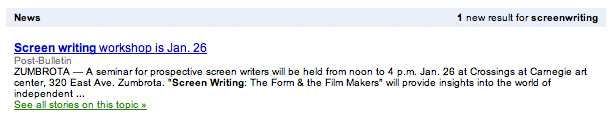
galert03

Again, another broad topic but only one search result. Not very useful, as I don’t live in Zumbrota, MN and therefore wouldn’t be able to attend their screenwriting workshop.

Online community
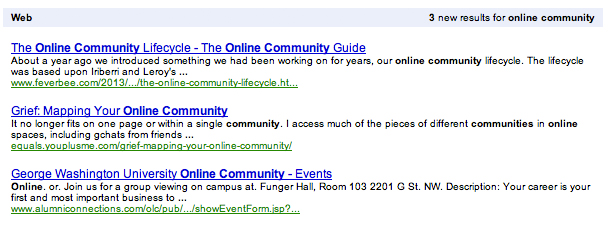
galert04

Of the three links sent to me for this topic, the first one was by far the most useful. As a Community Manager myself, I’m always doing research on ways to grow and manage online communities. This article was well-researched but easy to understand and translate into my own scenario, and I’ve bookmarked it for future reference. A really valuable find, and something I may never have come across if I hadn’t set up this Google alert!

What kind of topics do you find Google Alerts useful for? Share you favourite results in the comments below…
Standard
Networked Media, Produce This!

Is eBay still a fair and equitable marketplace?

When eBay’s founder Pierre Omidyar first developed the site, his original vision was to create a “fair and equitable marketplace” where the little guy could have as good a chance to compete with the big guys as possible through a new online auction platform.

Almost twenty years on from the global auction site’s humble beginnings, does the reality still live up to Omidyar’s idealistic vision?

I would argue that no, it doesn’t. A lot has changed since 1995 and it appears that the commercialisation of the web has succeeded in pushing ideals aside for profits.

I first registered as a buyer and seller on eBay in 2003. I honestly can’t believe that I didn’t register sooner because, before I knew it, I was selling off second-hand clothing, books, CDs, video games, toys, and a ton of junk that was just lying around the house. I was also making quite a bit of pocket money in the process. Over time I got more adventurous, buying things on sale in stores that I thought would have good resale value on eBay. I certainly wasn’t earning millions, but it was enough to help me pay for other things that interested me, like hobbies and overseas travel.

But eBay’s business model progressively changed and, as one of the ‘little guys’ who was just having fun and earning a bit of spare cash from behind their PCs, it became more and more difficult to sell through the site.

eBay’s interests have changed. They don’t want to be seen as a virtual flea market anymore. They want to emulate the successful Amazon.com business model, and become a virtual marketplace for the big guys. Users like me are just small fry and, even though we’re the reason that eBay became so successful in the first place, the tiny listing and final value fees earned off of second-hand books and knick knacks are not going to be enough satisfy the shareholders and Board of Directors.

I knew it was the beginning of the end back in 2008 when eBay decided that they wanted to force sellers to offer PayPal as the only payment option on listings. Up until then, you could offer it, but it wasn’t compulsory. eBay owns PayPal and would potentially earn an extra 2-3% in fees per transaction if the proposal went ahead. What they were proposing is essentially known as third-line forcing, and it’s strictly prohibited by Australian trade practices law. The ACCC got involved (I was so passionately against this proposal that I even made a submission to the ACCC myself!) and their final decision was that it was anti-competitive behaviour and eBay’s notification was revoked.

Despite this positive outcome, there was a marked change to the atmosphere on eBay. It didn’t feel like a place for the little guys anymore. I stopped selling on eBay around that time and only returned recently to see whether things had improved. They haven’t, in my opinion, and if anything they have gotten worse. Fee structures have been changed dramatically so that small-time sellers have been priced out of using tools like the eBay store, and the item searches have been tweaked so that listings from larger sellers get priority over smaller ones.

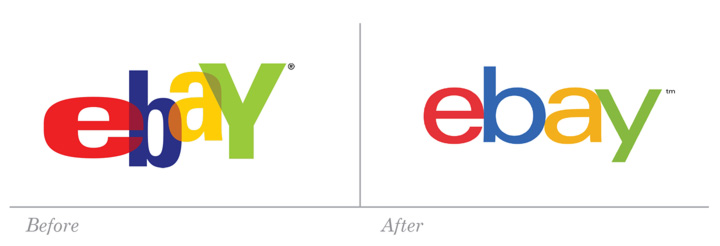
They’ve even redesigned their original logo (you can judge for yourself which one you prefer!)

Image courtesy of Truly Deeply blog

Image courtesy of Truly Deeply blog

So, from my personal experience, I don’t believe that eBay is still a fair and equitable marketplace. It has evolved, certainly, but whether that is for better or worse is up to the future to decide. In my mind, it’ll always be a place that offered great opportunities for average people to start their own businesses, and gain freedom and autonomy over their lives. Who knows where they’ll go to do that now (Etsy, perhaps?)

[ This post is a response to Download: The True Story of the Internet, Episode 3 – Bubble ]

Standard
Networked Media, Produce This!

Blog strategy for dealing with comments and spam

Dealing with inappropriate comments is something I’m quite familiar with as I have to moderate them regularly at work. We often have members writing reviews or commenting on reviews in an inappropriate way. It might be a case of their breaching our Fair Play Policy, or the website’s Conditions of Use. It’s not always on purpose, either, so we try to educate our users in order to reduce the number of instances when inappropriate comments come up.

We’re lucky enough to have a content verification system that does most of the work for us. It picks up on particular keywords and phrases and will temporarily retract content until one of our staff members can manually verify it. Members also have the ability to flag content they believe is suspect and/or inappropriate in some way so that it can be investigated.

Most bloggers are not so lucky, and will need to manually check all of the comments that are posted to their blog for spam and/or inappropriate content. That being said, it’s not actually too daunting of a task. A very large percentage of bloggers probably won’t get much traffic, let alone comments or user activity. Spam will still slip through, though, and trolls are everywhere, so it’s good to have a strategy in place to deal with any issues that may arise.

The strategy and guidelines that I will implement for my own blog are informed by my experience both at work, and as a long-time blogger and forum user. My strategy is as follows:

  1. Install a plugin that can help with comment moderation. The Akismet plugin is recommended for WordPress blogs, as it was developed specifically for them and (from my own experience) works pretty well.
  2. At the end of every blog post, add a ‘call to action’ and ask readers to comment on the topics raised in the post (because if you’ve got no comments then there is no point in having a comment strategy!)
  3. When moderating comments:
    • Is the comment blatant spam? Delete it
    • Has someone commented on the article but used it as a backhanded way to link to their own blog/website?1 Delete it
    • Does the comment contain profanity, personal attacks or other inappropriate content? Delete it
    • Does the comment appear to be legitimate but off-topic? Use personal judgement and either approve or delete it on a case-by-case basis
    • Everything else is probably fine and can be approved.
  4. Respond to the comment (it helps when your blog theme allows nested comments) and thank the visitor for taking the time to contribute. Don’t forget to address any questions they may have raised as well.

It’s pretty simple, but it should do the job!

1. This is a tough one. Some people use this method to build traffic to their own blog and/or work on their SEO. I don’t feel that this kind of commenting makes a genuine contribution to a community and so, personally, I wouldn’t approve the comment.

Standard
Networked Media, Produce This!

Why Curation still has a place in modern day Search

The claim that Google revolutionised search is almost certainly indisputable. Larry Page and Sergey Brin developed a solution that made the increasingly impossible task of indexing and searching the Internet a reality. They also seeded something that would grow to become a multi-billion dollar industry.

Google’s solution is certainly a better fit for the problem of indexing an ever-growing amount of data. The traditional system used by former search giant Yahoo! in the 1990s, involving hundreds if not thousands of staff to manually approve and index website submissions for their search index, may have been feasible in the beginning. As the amount of content available on the web began to grow exponentially, however, this system fast became too expensive and too slow for the demands of a growing web audience.

Google is certainly meeting the demand for providing quick and relevant search results. But as Gandhi once said, “There is more to life than simply increasing its speed.” I would argue that there is still an important place for digital curation in modern day Search – a sort of ‘slow search’ movement, if you will. As the amount of web ‘junk’ and recycled content continues to rise, the need for manual cataloguing of niche content by independent thought leaders has become essential.

Some examples of digital curation projects include Jason Hirschhorn’s Media ReDEFined, Maria Popova’s Brain Pickings and Australia’s own The Fetch newsletter. The curators behind these projects spend hundreds of hours a month trawling the Internet looking for the best quality content that fits their niche and informs their audience. It’s not an easy job; it certainly takes a lot of time and effort to provide this service on a regular basis. But there is a guarantee of quality that lends authority to the curation project, increases trust in the curator and builds a dedicated and satisfied audience.

While Google keeps tweaking the way it produces the most ‘relevant’ search results – and SEO experts keep trying to game the system – digital curators will continue to provide an independent source of quality content. Maybe a little slower but, as they say, good things come to those who wait.

[ This post is a response to Download: The True Story of the Internet, Episode 2 – Search ]

Standard

Anonymity Project: The PostSecret Effect by kzhines

Anonymity Project… is a research documentary that explores the ways in which people are interacting anonymously over the Internet in order to make connections within an increasingly disconnected world.

The author argues that people want to be “known”, and are learning to navigate through the opposition that is the public space of the internet (where we present ourselves and at the same time learn how to self-reflect and become more self-aware) versus the market economy (that is driving us toward authenticity and a desire to connect with strangers.)

Like a well-written essay, the author has logically and succinctly expressed her arguments and evidence – albeit visually. She has used simple editing techniques that have strengthened the narrative with appropriate visual cues.

The author doesn’t bombard the viewer with examples to back up her claims. She uses three perfectly-pitched examples to move her argument along. The video itself is brief and well paced.

The music selected for the video compliments the narrative and provides an emotional depth that allows the viewer to connect with the content in a deeper way.

I like the way the author has chosen to keep themselves anonymous throughout most of the video by only showing part of their face. This framing choice reinforces the argument the author is making about the anonymity of the medium. I also think it’s a pretty neat use of editing to “reassemble” the piece of paper at the end of the video (which also provides a visual representation of the ‘conclusion’ of essay).

Overall, the argument being made by the author resonates with me. As someone who has an academic interest in online communities, it also provided me with something new to consider. The video was easy to understand and entertaining to watch. Recommended viewing for Media students!

Learn more about the online communities referenced in the video: